
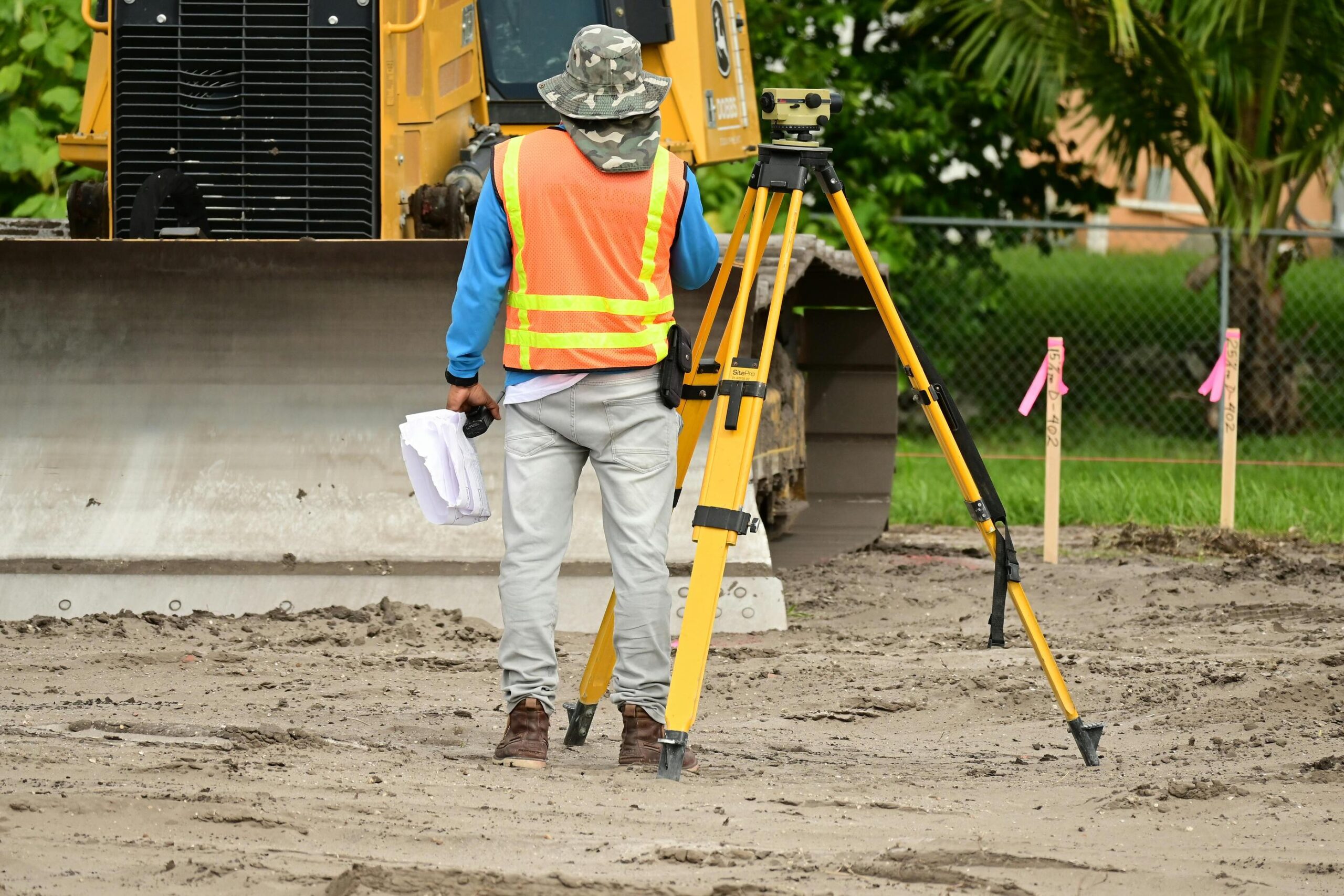
Surveying has evolved dramatically over the past few decades, transitioning from manual chains and optical levels to sophisticated digital systems capable of capturing millions of precise data points in seconds. As construction becomes more complex and cities grow vertically, surveyors are expected to deliver higher accuracy, greater efficiency, and richer spatial data than ever before. Modern surveying tools enable practitioners to meet these demands while improving workflow, safety, and integration with architectural and engineering processes.
This article provides an in-depth look at today’s surveying technologies, how they are used, and why they are essential in Malaysia’s rapidly developing built environment.
1. Total Stations: The Workhorse of Modern Surveying
The total station remains the most widely used instrument for precise angle and distance measurement. It combines the functions of a theodolite with an electronic distance meter, allowing surveyors to measure coordinates accurately.
Modern total stations offer:
- Automatic target recognition
- Reflectorless measurement
- Advanced onboard software
- Robotic control for single-operator surveys
- Data transfer to CAD/BIM platforms
They are essential for boundary surveys, building layout, structural alignment checks, and engineering measurements.
2. GNSS & Satellite Positioning Systems
Global Navigation Satellite System (GNSS) receivers have revolutionised outdoor surveying, particularly for large or open sites. Using satellite signals, GNSS can determine positions with centimetre-level accuracy when using techniques such as RTK (Real-Time Kinematic).
Common GNSS applications include:
- Establishing control points
- Geodetic surveys
- Mapping large land parcels
- Infrastructure alignment
- Terrain modelling
Malaysia’s adoption of the GDM2000 geodetic datum and availability of local CORS networks have further boosted GNSS reliability and accuracy.
3. Digital Levels & Laser Levelling Tools
Precise height determination is crucial in construction, drainage design, roadworks, and structural monitoring. Digital electronic levels offer:
- Automated reading and recording
- Reduced human error
- Fast measurement speeds
- High repeatability
Laser levels and rotating lasers are frequently used on construction sites for levelling slabs, plumbing lines, and formwork.
4. UAVs (Drones) and Aerial Mapping
Unmanned Aerial Vehicles (UAVs) have become a mainstream surveying tool due to their speed, efficiency, and ability to access difficult or dangerous areas.
Surveyors use drones to produce:
- Orthophotos
- Terrain models
- Cut-and-fill calculations
- Progress monitoring imagery
- Façade inspections
With high-resolution cameras, drones can map large areas in minutes, replacing manual ground surveys for many preliminary tasks.
Regulatory compliance is important, and surveyors must follow drone operation guidelines set by local aviation authorities.
5. LiDAR & 3D Laser Scanning
3D laser scanning is one of the most transformative technologies in modern surveying. Using LiDAR sensors, scanners emit thousands of laser pulses per second to capture millions of spatial points.
Benefits include:
- Highly accurate point clouds
- Detailed as-built documentation
- Capture of complex geometries
- Fast measurement of large structures
- Ability to work in low light or indoor conditions
Laser scanning is widely used for:
- Heritage building documentation
- Plant and industrial facility modelling
- Façade inspections
- BIM model creation
- Fit-out and renovation projects
Handheld mobile scanners now allow even faster on-site capture, especially in tight interior spaces.
6. BIM Integration & Digital Construction Tools
Surveyors increasingly work with Building Information Modelling (BIM), which integrates geometry, specifications, and performance data into a single digital model.
Survey technology now feeds directly into BIM workflows to:
- Validate as-built conditions
- Detect clashes or deviations
- Update models in real time
- Improve collaboration between disciplines
Laser scanning, total stations, and GNSS instruments can export data into BIM software, enabling surveyors to play a central role in digital construction.
7. Photogrammetry & Image-Based Modelling
Photogrammetry uses overlapping photographs to generate 3D models and orthophotos through specialised software. It is widely used for:
- Topographic mapping
- Earthwork measurement
- Façade capture
- Preliminary site surveys
Compared to LiDAR, photogrammetry is cost-effective and ideal for aerial mapping projects where high point-cloud density is not critical.
8. GIS & Spatial Data Platforms
Geographic Information Systems (GIS) help surveyors manage, analyse, and visualise geospatial data. GIS platforms allow survey data to be integrated with layers such as:
- Land titles
- Utilities
- Zoning maps
- Flood risks
- Infrastructure corridors
Governments and private developers increasingly rely on GIS for planning and decision-making.
9. Cloud-Based Surveying & Field Data Apps
Cloud technology enables surveyors to:
- Upload field data instantly
- Sync measurements across teams
- Access drawings and models onsite
- Share point clouds and 3D meshes
- Track project progress remotely
This improves collaboration and reduces delays caused by incomplete or outdated information.
Mobile field apps can also replace paper records, standardise field workflows, and reduce administrative errors.
10. Automated & Robotic Systems
Robotic total stations, autonomous scanners, and automated monitoring systems represent the next generation of surveying tools. These systems can:
- Continuously track structural movement
- Monitor settlements
- Perform periodic alignment checks
- Automate long-term data capture
Automated deformation monitoring is increasingly used for high-rise towers, bridges, tunnels, and geotechnical risk areas.
Challenges in Adopting New Survey Technology
Despite the benefits, modern technology brings challenges, including:
- High equipment costs
- Steep learning curves
- Issues integrating old and new datasets
- Software compatibility limitations
- Regulatory inconsistencies
- Need for continuous training
Survey firms must balance technological ambitions with practical budget constraints and staff competencies.
The Future of Surveying Technology
The next decade will bring even more advanced tools into the surveyor’s toolkit, such as:
- AI-enhanced point cloud processing
- Automated GNSS networks
- Ultra-portable handheld LiDAR
- Real-time digital twins
- Autonomous survey robots
- Cloud-native BIM systems
- Advanced terrestrial photogrammetry
- Smart sensors for structural monitoring
These innovations will streamline workflows, reduce errors, and improve the precision and usefulness of spatial data.
Conclusion
Modern technology is transforming the surveying profession, reshaping how data is captured, processed, and delivered. Surveyors today must be competent not only in traditional measurement techniques but also in digital systems, data management, and multi-disciplinary collaboration. By embracing advanced tools such as drones, laser scanners, GNSS, BIM, and automated monitoring systems, surveyors help create safer projects, better documentation, and more efficient development.
As Malaysia continues to expand its urban landscape and infrastructure network, the importance of technologically skilled surveyors will only increase. The profession’s future belongs to those who combine strong foundational knowledge with modern digital capabilities.